Rue Verbier
Impure BloodRue Verbier is a leafy street near Nice’s main railway station whose ordinary city life converges with Friday prayer and a fatal crime. Its apartment balconies, pavement crowd, prayer room, and nearby shops make it both a lived-in neighborhood and a crucial landscape of observation: Marie Lacroix watches the events unfold from above, and her later account helps investigators reconstruct Emil Florian’s movements before his death.
Setting and Street Layout
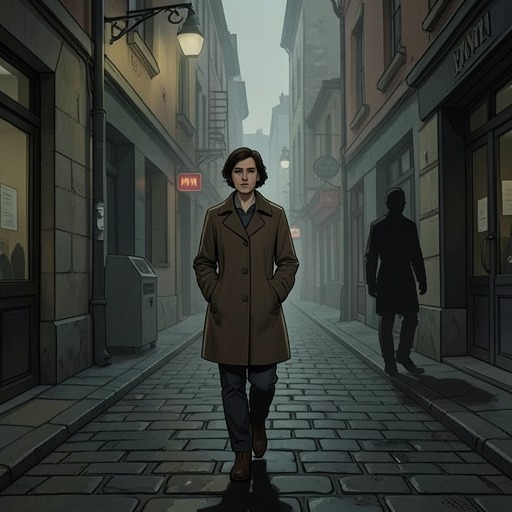
Among the airless, grimy streets clustered around Nice’s main railway station, Rue Verbier is described as a leafy oasis. It runs east to west. Apartment houses, some with shops and cafés at ground level, line its northern side; the Basilique Saint Eustache and an adjoining car park occupy the southern flank. The contrast places the street between residential and commercial activity on one side and the imposing church and its car park on the other.
At the end furthest from the basilica, just before the street opens onto a small marketplace, a former bistro houses a Muslim prayer room. Rue Verbier therefore holds distinct religious spaces within a short stretch: the basilica and the prayer room, as well as the pavement where worshippers gather when the latter cannot accommodate them. A phone booth outside a pharmacy also stands on the street, linking this neighborhood setting to the emergency call that brings the police investigation into focus.
A Friday at the Prayer Gathering
At 1:06 p.m. on Friday, 3 July, Marie Lacroix watches from her balcony on Rue Verbier as a tram arrives at the stop on Jean Médecin. She is waiting for a couple who have rented her holiday apartment, but they are late, so she turns her attention to the street. Among the activity she observes is a living-statue performer dressed as Medusa, whose animated snake headdress draws a crowd. The performer and her audience will later matter to the reconstruction of the day, because a collision takes place as people move away from the spectacle.
Marie first notices Emil Florian as a bald man in a white linen suit, with an Evian bottle in his pocket. He appears to mime tying a shoelace despite wearing slip-on loafers, then crosses the street to look at a circular billboard. Later, she sees him jogging past the basilica. He collides with a bearded young man carrying a rucksack, nearly knocking them both off balance, apologizes, and continues on. The details initially look like disconnected movements in a busy street; in the investigation, they become clues to Florian’s route and conduct.
The Friday congregation gathers near the street’s far end. The prayer room fills quickly, with older and more vulnerable worshippers among those who find places inside. Others pray outside, laying down mats or towels, or using flattened packing materials donated by nearby shops and cafés. Marie has seen the arrangement before. She contrasts the disturbance visitors can cause to Catholics praying inside the basilica with the interruptions faced by Muslims praying amid street traffic and public attention. The scene’s solemn choreography strikes her as beautiful, even as the street exposes worshippers to a less protected setting.
Florian joins the outdoor congregation, carrying a piece of cardboard to use as a prayer surface. His presence there changes the meaning of his earlier run: he was not trying to catch a train, as Marie had guessed, but trying to reach midday prayers. That apparent explanation does not, however, account for all of his movements. Later evidence connects his arrival on Rue Verbier to an attempt to evade Armani Tardelli and to conceal the GHB in his water bottle.
Crime Scene and Investigation
After Florian’s death, Rue Verbier becomes the site of an investigation whose practical difficulties arise in part from the street’s openness. An anonymous woman calls the emergency number from the phone booth outside the pharmacy, reporting that a Muslim has been killed on the street during a prayer service. The call supplies no further details. Because it is a free, cardless call, police cannot trace the caller unless she identifies herself or comes forward.
Paul Darac surveys the scene and recognizes that Rue Verbier offers investigators many potential sources of evidence. At least fifty apartment balconies and far more windows overlook the street; cameras in the car park may also have recorded what happened. The same density that offers possible witnesses creates a management problem: the scene has attracted so many people that investigators must identify and sort accounts rather than simply search for someone who saw the event.
Marie’s apartment is at number 67 Rue Verbier, where apartment 9 is a holiday rental she owns. The young couple staying there tell Alejo Busquet that Marie was half-upset and half-angry when they arrived late to collect the apartment. They initially assume she is annoyed with them, but she explains that something she has just witnessed on the street has appalled her. Her balcony position, opposite the basilica, gives her a sustained view of the area and makes her account particularly useful.
In a later interview, Marie provides a sequence that extends beyond the moment captured by Lartou’s CCTV footage. She saw Florian arrive before the footage begins, join the prayer gathering, and encounter the elderly Delage, who struck him with her shopping trolley. Marie also saw Florian bend forward as if praying and fail to rise again. Her account supplies investigators with a witness-based chronology, including both the apparent blow and the final movement she observed.
Reconstructing Florian’s Route
Marie’s observations also help explain the gap between Florian’s arrival in the area and his appearance at the prayer gathering. Busquet reasons that Florian first saw Armani on Jean Médecin and concealed himself behind a Colonne Morris. When Armani went into a Rue Verbier boutique, Florian attempted to run past him, using the crowd gathered for the living statue as cover. The collision with the rucksack-carrying young man fits into that attempted passage through the crowd.
The reconstruction then follows Florian to the outdoor prayer meeting. According to Busquet, Florian poured away the water containing incriminating GHB in a way that could look like an ordinary act by someone about to pray. The explanation depends on the setting: the gathering gives him a reason to handle the bottle without drawing attention. Marie’s account of the route, the crowd, and the collision helps distinguish that concealment from the ordinary movements of a worshipper arriving for prayer.
Rue Verbier thus acquires significance through the way its elements are joined: the tram stop and nearby shops, the street performer’s audience, the balcony overlooking the pavement, the prayer space, and the phone booth used to report the death. Each creates a different vantage or opportunity, and together they make the street legible to investigators after the fact. What began for Marie as a view from home becomes a detailed record of Florian’s arrival, his passage through the crowd, and his entry into the congregation where he died.